Understanding the emotions that shape your conversations
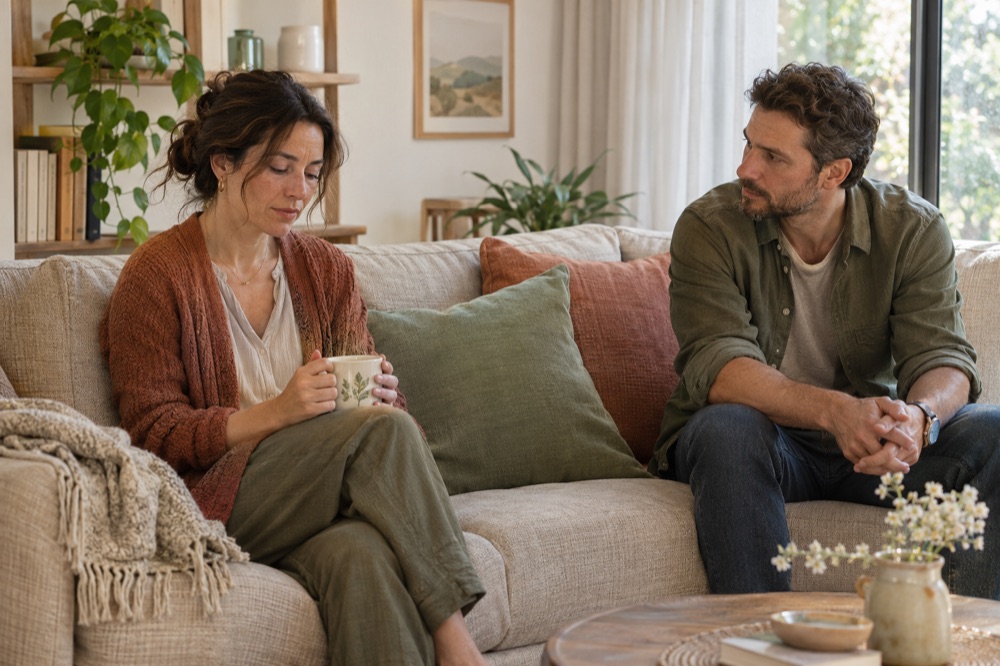
Emotions shape our relationships. They can give us clues to what we need, what we miss and what has hurt us. It can take practice to name what you’re feeling and decide how to respond.
In a couple, understanding the dominant emotions of your partner is an essential key to avoiding misunderstandings and strengthening your complicity. Because when you know what motivates or disturbs the other, you become not only a precious support, but also a source of serenity and balance.
Why understand the dominant emotions is essential?
Emotions are not just reactions; they are guides. They express our basic needs, whether they be respect, security, or love. However, when these needs are not met, emotions can become invasive or even destructive.
-
An unconscious on alert: As Virginia Satir explains, unrecognized or ignored emotions do not disappear. They accumulate, shouting increasingly loudly whenever a need remains unsatisfied.
-
Example: A person who has not been respected in childhood can develop hypersensitivity to any form of neglect, which can lead to frequent conflicts, even for "small things."
-
-
The link with disputes: Recurrent disputes in a couple are often an echo of unsolved dominant emotions. Identifying these emotions is laying the foundation for healthy and respectful communication.
Marine and Paul – The Weight of Repressed Emotion
Background
Marine and Paul, in a couple for six years, share a great complicity, but regularly their exchanges become disputes, especially when Paul arrives late or forgets to respond to a message.
The problem
Marine, who grew up in a family where emotional security was lacking, is hypersensitive to anything that looks like abandonment or indifference. Paul, not understanding the origin of these reactions, feels unfairly criticised and reacts by withdrawal or defense.
The solution
In pre-nup advice, they learned to:
-
Identify the dominant emotions: Marine became aware that her sense of insecurity came from unsolved childhood injuries.
-
Clearly express the needs: Marine learned to formulate its expectations without reproach, and Paul began to validate Marine's emotions instead of ignoring them.
-
Create habits of mutual support: They have established a "listening ritual" every week to share their feelings without judgment.
Identify the emotion behind an argument
When a conversation goes off track, it can be hard to tell whether you’re mainly afraid, sad or angry. We can revisit a specific moment and untangle those feelings.
How to identify the dominant emotions of your partner?
-
Observe moments of tension:
-
What behaviours trigger strong reactions in your partner?
-
Are there repetitive patterns in these situations?
-
-
Analyze conflicts with others: If your partner frequently fights with colleagues, friends or family, it may reveal an unsolved dominant emotion.
-
Pay attention to the critics: Behind each critic is an emotion. For example:
-
Repeated anger may reveal a need for respect or recognition.
-
Persistent sadness may indicate a sense of abandonment or insecurity.
-
-
Ask open questions:
-
"What bothers you the most in this situation?"
-
"What would you need to feel better about?"
-
-
Note the disproportionate reactions: An overexpressed emotion is often the sign of a deeply rooted need.
Practical practices to better manage and understand emotions
-
Keep an "emotional diary" as a couple: Note your emotions every day and share them together to better understand you.
-
Plan regular discussions: Reserve a moment every week to talk about your emotions, in a calm and caring setting.
-
Create a validation space: Learn to listen without interrupting or judging. Validate your partner's emotions by saying, for example, "I understand that you feel like this."
-
Train yourself in the management of emotions: If emotions become uncontrollable, consider taking sessions to learn how to better manage them, as a couple or individually.
-
Seek prenup advice: An outside look can help translate your differences into opportunities for mutual growth.
Why is this part of a prenup advice?
This is one of the points that we discuss during pre-nuptial counselling sessions. If you have not explored this approach yet, think about it, regardless of the level of advancement of your couple. Pre-nuptial counselling is an essential step in:
-
Improve communication in your couple.
-
Achieving your common goals faster.
-
Make your home a peaceful, inspiring and energizing place.
"Emotions are waves that come and go. Some are soft and bent, others are storms. But with patience and listening, You will learn to surf on their ridges, together."
Mawlānā Jalāl ad-Dīn Rūmī